Timing Validation
Why “TachyPy”?
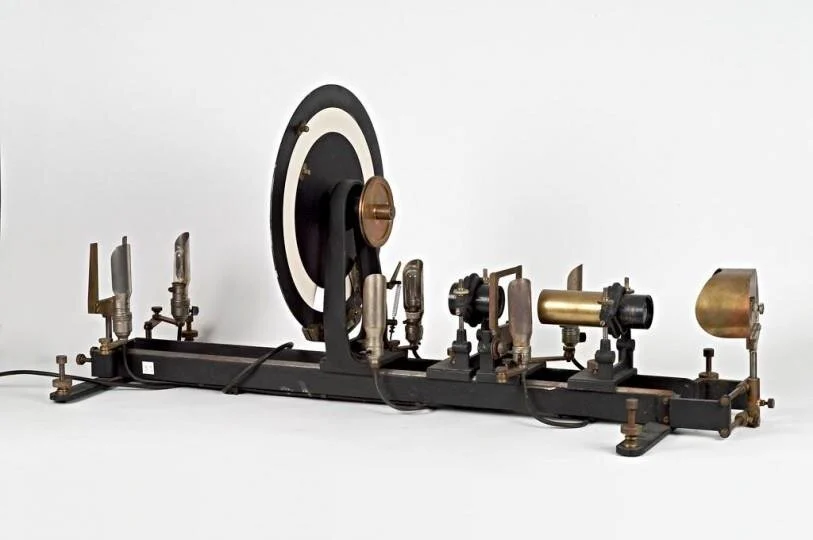
TachyPy is named after the tachistoscope, a classic laboratory instrument used to present visual stimuli for precisely controlled, brief durations. The goal of TachyPy is to provide the same timing discipline for Python psychophysics experiments while keeping experiment code readable and inspectable.
Photodiode test
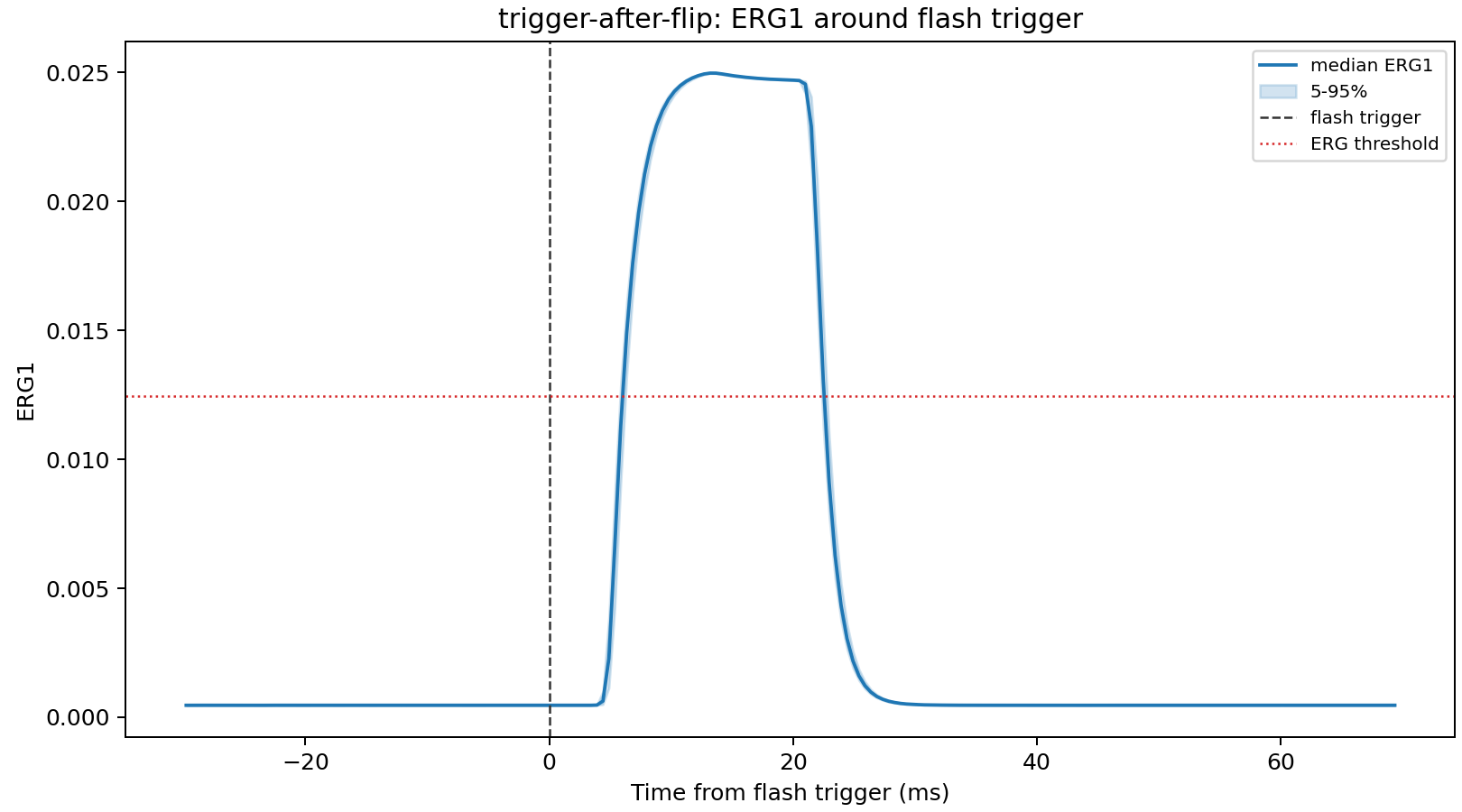
The GLFW backend was tested with a photodiode setup using a centrally presented white square on a uniform gray background. The white square was shown for one frame on a 60 Hz monitor. The photodiode was placed at the screen center, over the white square, and the EEG recording captured both serial trigger events and the photodiode signal.
The after-flip trigger condition is shown here. The dashed line marks the serial flash trigger. The blue trace is the median photodiode waveform, with the shaded region showing the 5th to 95th percentile range across flashes.
Summary for this run:
Median rise after flash trigger:
6.35 ms.SD of rise after flash trigger:
0.20 ms.Median photodiode pulse width:
16.60 ms.SD of photodiode pulse width:
0.18 ms.
Interpretation
The photodiode is the hardware reference for photon onset at the measured screen location. TachyPy’s software flip timestamps are useful for experiment logs, but they should be interpreted as display-swap timestamps rather than direct photon onset measurements. Exact photon timing depends on display scanout, the stimulus location, panel response, and display electronics.
For timing-critical validation, combine:
TachyPy flip timestamps.
Serial trigger timestamps in the acquisition system.
Photodiode traces at the relevant stimulus location.
Practical implication
The first frames after display/context creation can be less stable on real
hardware. TachyPy therefore presents neutral gray warmup frames by default when
Screen is initialized. The warmup can be tuned with warmup_frames or
disabled with warmup_frames=0.